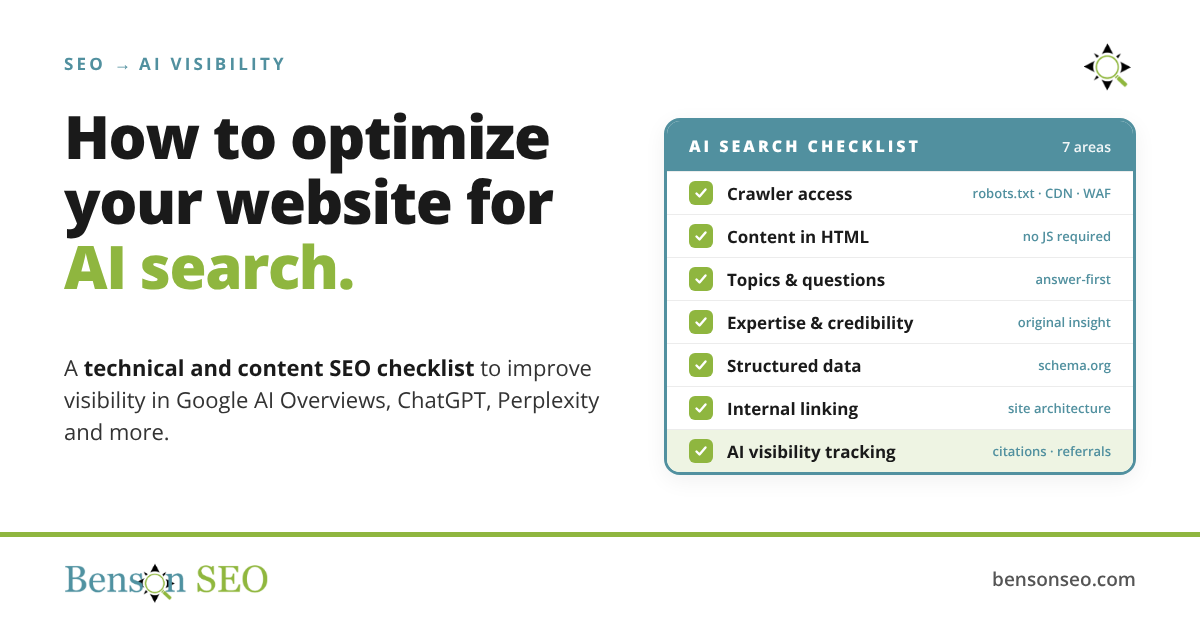
Search is changing. Google’s AI Overviews and AI Mode, along with platforms like ChatGPT, Perplexity, and Claude, are changing how people discover information, evaluate businesses, and make purchasing decisions.
Instead of searching for a few keywords and clicking through a list of websites, users can ask detailed questions and receive AI-generated answers that combine information from multiple sources. Those answers may include citations and links, or recommendations for specific brands, products, or services.
For businesses, this introduces a new challenge: How do you optimize your website to improve visibility in AI-powered search results?
The good news is that many of the same technical SEO and content optimization practices that improve traditional organic search visibility also provide the foundation for AI search. However, businesses should also consider how their content is structured, how their expertise is communicated, and how their brand is represented across the web.
This guide outlines practical steps to prepare your website for AI search, from technical SEO fundamentals to content optimization and AI visibility measurement.
1. Understand How AI Search Engines Discover and Use Content
Before making changes to your website, it’s important to understand how AI search differs from traditional search engines.
Traditional search engines crawl websites, index content, and rank pages based on relevance, quality, and other signals. AI-powered search application can build on these systems by retrieving information from multiple sources and combining it into a conversational answer.
Google’s AI Overviews and AI Mode, for example, use Google’s existing search infrastructure and ranking systems. Google has explicitly confirmed that foundational SEO practices remain relevant for appearing in its generative AI search experiences.
Other platforms, including ChatGPT and Perplexity, may use a combination of web search, retrieval systems, and language models to generate responses. They literally perform live searches on Google and Bing to retrieve information.
Although their approaches differ, several principles apply across AI-powered search experiences:
- Discoverability: Search engines and retrieval systems need to find your content.
- Accessibility: Important information should be available in a format that crawlers can access and interpret.
- Relevance: Your content should address the questions and topics users are researching.
- Credibility: Your website should demonstrate expertise, accuracy, and authority.
- Clarity: Information should be organized so both human readers and automated systems can understand it.
It’s also important to distinguish between being indexed, being retrieved as a source, and being cited in an AI-generated answer. These are different outcomes, and no optimization technique guarantees inclusion in AI responses.
The objective of AI website optimization is to improve the conditions that make your content discoverable, useful, and credible.
2. Make Sure Your Website Is Accessible to Search and AI Crawlers
Technical SEO is the foundation of any effective AI search optimization strategy.
If search engines cannot crawl your website or access important content, your opportunities for visibility may be limited before content quality is even considered. This is why a comprehensive SEO site audit is critical to visibility across search applicaitons.
Review Robots.txt and Crawler Access
Start by reviewing your website’s robots.txt file, which provides instructions to compliant web crawlers about which areas of your website they can access. For Google AI Overviews and AI Mode, Googlebot access and eligibility for indexing are essential. Google does not require a separate AI-specific crawler configuration for these features. Other AI platforms operate their own crawlers, and some distinguish between crawling for search functionality and crawling for model training.
For example, OpenAI identifies different crawlers for search-related functionality and model training. Website owners should understand these distinctions before deciding which crawlers to allow or restrict.
Review the following:
- Confirm that important website sections are not unintentionally blocked in robots.txt.
- Check whether your hosting provider, CDN, or web application firewall is blocking legitimate crawlers.
- Investigate HTTP 403 errors affecting search engine or AI crawlers.
- Review server logs to understand which crawlers are accessing your website.
- Evaluate crawler permissions according to your organization’s content and data policies.
Keep in mind that allowing an AI crawler does not guarantee that your website will appear in AI-generated answers. Likewise, blocking a crawler used for model training does not necessarily prevent a platform from discovering your content through other search or retrieval systems.
Ensure Important Content Is Available in HTML
Modern websites frequently rely on JavaScript to render content, navigation, and interactive elements. While Google can render pages that utilize JavaScript to load content, other crawlers and retrieval systems may have more limited rendering capabilities. They aren’t as sophisticated as the Google bots. As a practical precaution, important website content should be accessible without requiring complex client-side rendering.
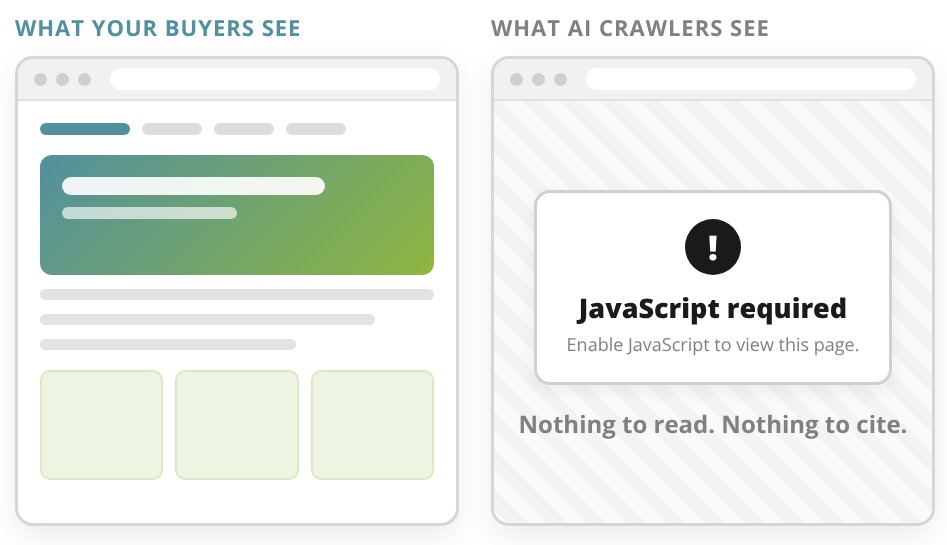
Prioritize making the following information available in the initial HTML response or through reliable server-side rendering:
- Main page headings and primary body content
- Product and service descriptions
- Important navigation links
- Pricing and feature information, where applicable
- Author information and supporting references
Use a crawler such as Screaming Frog SEO Spider to compare the raw HTML with the rendered version of important pages. Significant differences may reveal content that certain crawlers cannot easily access.
Review XML Sitemaps and Indexing
What role do XML sitemaps play in AI optimization?
XML sitemaps help search engines discover important URLs and identify recently updated content. They are particularly useful for large websites, frequently updated publishers, and websites with complex structures. For AI-powered experiences that rely on traditional search indexes, such as Google’s AI Overviews, XML sitemaps support the initial discovery process. However, XML sitemaps are not a direct AI ranking factor, nor do they guarantee inclusion in AI-generated answers.
Your XML sitemap should:
- Include important, canonical, indexable URLs.
- Exclude redirected, duplicate, and intentionally non-indexable pages.
- Use accurate last-modified dates when content meaningfully changes.
- Be submitted and monitored through Google Search Console.
- Remain consistent with canonical tags and internal linking.
For larger websites, separate sitemaps for articles, products, or other major content types can simplify monitoring and troubleshooting. A clean XML sitemap helps search engines discover your content efficiently, but it should complement rather than replace a strong internal linking structure.
3. Organize Website Content Around Topics and Questions
Traditional SEO often focuses on identifying relevant keywords and optimizing individual pages around those phrases. Keyword research remains important, but AI-powered search creates additional opportunities around more conversational, detailed, and multiple layered questions.
For example, someone researching customer success software might search Google for:
“customer success software”
But when using an AI assistant, that same person might ask:
“What customer success platforms integrate with Salesforce, offer predictive churn analytics, and work well for mid-sized SaaS companies?”
The second query contains multiple requirements and may prompt the AI system to retrieve information from several related topics. This means your website content needs to address all of these topical queries.
Build Content Around Related Search Intents
Rather than publishing multiple pages that target slight variations of the same keyword, organize your content around distinct user needs.
A software company, for example, might develop content covering:
- How its software solves a particular business problem
- Product capabilities and integrations
- Implementation requirements and timelines
- Comparisons between different approaches
- Pricing considerations and total cost of ownership
- Common challenges and recommended solutions
Each page should have a distinct purpose while linking to other relevant resources. This approach helps create a more useful experience for readers and gives search and retrieval systems access to relevant information across the buyer’s journey.
Use Clear, Descriptive Headings
Your page structure should communicate what each section covers. Use one descriptive H1 heading, followed by logically organized H2 and H3 headings. Whenever appropriate, use headings that reflect questions your audience actually asks.
For example:
Less descriptive: “Additional Considerations”
More descriptive: “How Does Website Speed Affect AI Search Optimization?”
The second heading provides clearer context for readers and automated systems. You don’t need to turn every heading into a question. The goal is to make the page’s information architecture logical, descriptive, and easy to navigate.
Provide Direct Answers Supported by Detail
When a section addresses a specific question, provide a clear answer before expanding into supporting information.
For example:
Does structured data improve AI search visibility?
Structured data helps search engines understand information about a webpage and can support eligibility for certain search features. However, there is no evidence that adding schema markup alone guarantees citations or recommendations in AI-generated answers.
After providing the direct answer, the article can explain appropriate schema types, implementation considerations, and limitations. This writing approach benefits human readers who want quick answers while also providing sufficient context for more detailed research.
Avoid unnaturally dividing content into small sections simply to accommodate AI systems. Some have called this “content chunking”. Google has specifically cautioned against unnecessary content formatting tactics marketed as special requirements for generative AI search.
4. Strengthen Content Quality, Expertise, and Credibility
One of the most important opportunities in AI search optimization is creating content that offers something more valuable than generic information. AI systems can summarize widely available information. Businesses therefore have an opportunity to differentiate themselves through original research, professional experience, useful data, and specific insights.
Google’s guidance for generative AI search emphasizes the importance of unique, valuable content rather than material that simply repeats information available elsewhere (a tired and low-quality SEO tactic).
Publish Original Insights and Evidence
Consider how your organization can contribute information that other websites cannot easily reproduce.
Examples include:
- Original research and survey findings
- Customer case studies with measurable outcomes
- Proprietary data and industry benchmarks
- Expert commentary on emerging trends
- Detailed implementation examples
- Firsthand product testing or comparisons
For example, an article explaining how to improve website performance becomes more valuable when it includes real testing results, screenshots, technical findings, and before-and-after measurements. Similarly, a software comparison is more useful when it explains specific use cases, limitations, integrations, and implementation considerations rather than repeating vendor marketing descriptions. Original information gives readers a reason to visit your website and can make your content a more useful reference for other publishers and AI-powered search systems.
Make Expertise Easy to Verify
Businesses should also make it easy for visitors to understand who created their content and why that person or organization is qualified to discuss the subject.
Useful practices include:
- Publishing author biographies with relevant professional experience
- Identifying subject matter experts and contributors
- Linking to supporting research and authoritative references
- Keeping factual information accurate and up to date
- Providing clear company information and contact details
- Maintaining consistency between website content and external business profiles
These practices support transparency and trust. They should not be treated as a checklist of guaranteed AI ranking factors.
Maintain Accurate Brand Information Across the Web
We know AI-generated responses can pull information from multiple websites and sources. That makes your organization’s broader digital presence an important consideration. Review how your company is described across relevant directories, professional profiles, industry publications, partner websites, and other authoritative sources. Look for inconsistencies in company descriptions, service offerings, product capabilities, or outdated information. Digital PR, industry relationships, and relevant third-party coverage can help strengthen your brand’s visibility and credibility.
The end-goal is to develop a genuine, consistent online presence, not to manufacture mentions or citations solely to influence AI-generated answers. Kind of like old-school SEO link building that no longer works. Quality over quantity is key.
5. Implement Structured Data Where It Adds Value
Structured data provides machine-readable information about the entities and content on your website. By using Schema.org markup, websites can identify information such as organizations, articles, products, authors, and other relevant entities. This allows websites to “spoon feed” these bots relevant information to help them understand the organization and content.
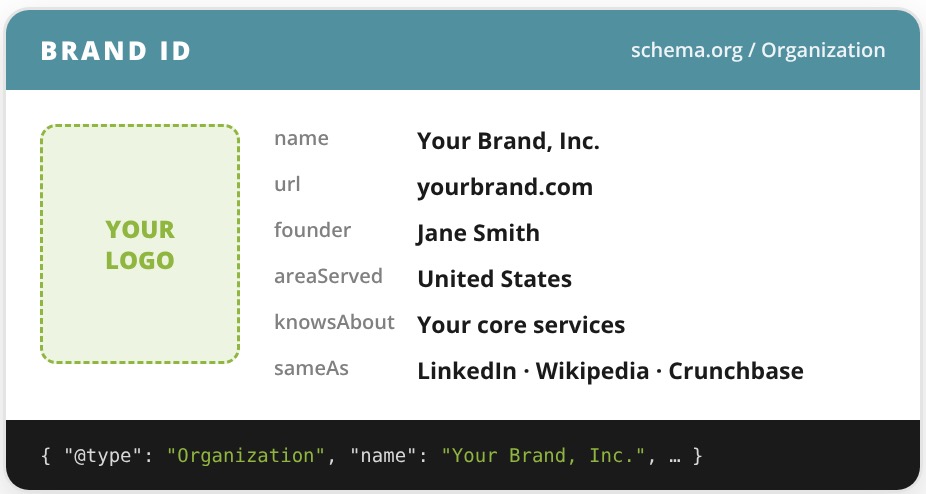
Google uses supported structured data to better understand content and enable certain search result features. However, there is no special schema markup required to appear in Google’s AI Overviews or AI Mode. For most businesses, the best approach is to implement structured data that accurately represents existing content.
Depending on the website, useful schema types may include:
- Organization: Information about your company and its identity.
- Article or BlogPosting: Information about editorial content, authors, and publication dates.
- Product: Relevant product details and attributes.
- BreadcrumbList: The hierarchical relationship between pages.
- LocalBusiness: Appropriate business details for organizations with eligible local operations.
Structured data should match the information visible on the page to human users. Use Google’s Rich Results Test for supported search features and Schema.org validation tools to check the accuracy of the code. Avoid adding irrelevant schema types or assuming that additional markup automatically improves AI search visibility.
6. Improve Internal Linking and Website Architecture
Internal linking remains a fundamental SEO practice that also supports AI search discoverability. Search engines use internal links to discover pages and understand relationships between content.A clear internal linking structure helps establish connections between broad topics and more specific resources.
For example, a business offering cybersecurity services might have a primary service page supported by articles about:
- Cybersecurity risk assessments
- Regulatory compliance requirements
- Common security vulnerabilities
- Incident response planning
- Security technology comparisons
Each supporting article can link to relevant service pages and related educational resources. This creates logical pathways for visitors while making the website’s topical organization easier to understand. Use descriptive anchor text that explains the destination page rather than generic phrases such as “click here.” Also review important pages for orphaned URLs, excessive click depth, and navigation issues that could limit discovery.
7. Measure Visibility in AI-Powered Search Results
Optimizing for AI search introduces measurement challenges that traditional SEO reporting does not fully address. Organic rankings, clicks, and impressions remain important, but they do not tell the complete story of how a brand appears in AI-generated answers. A business might be mentioned or recommended in an AI response without receiving a website visit. Conversely, an AI citation may generate a highly qualified visitor who is further along in the purchasing process. An effective measurement strategy should combine traditional search analytics with AI visibility monitoring.
Continue Monitoring Google Search Console
Google Search Console remains an essential resource for understanding how Google discovers, indexes, and displays your website.
Monitor:
- Search impressions and clicks
- Search queries and landing page performance
- Indexing coverage
- Technical issues
- Performance trends for important content
Use the generative AI performance reporting available in your Search Console property, where supported, to evaluate visibility in Google’s AI search experiences. Keep in mind that Google Search Console does not provide a complete picture of your visibility across independent AI platforms such as ChatGPT, Claude, or Perplexity.
Track AI Referral Traffic in Google Analytics
Google Analytics 4 can help identify traffic referred by AI-powered platforms when referral information is passed through to your website.
Create reports or explorations that identify relevant AI referral sources and evaluate:
- Sessions and engaged sessions
- Landing pages receiving AI referrals
- Key events and lead conversions
- Engagement rates
- Conversion performance relative to other channels
AI referral data has limitations. Some interactions may not generate a website visit, and some traffic may be attributed to other sources or appear without identifiable referral information. For this reason, referral traffic should be treated as one component of AI visibility measurement rather than a comprehensive measure.
Monitor Brand Mentions and AI Citations
AI visibility monitoring platforms can help businesses evaluate how frequently their brands appear in responses to relevant prompts.
Depending on the platform, these tools may provide information about:
- Brand mentions and recommendations
- Website citations
- Competitor visibility
- Sentiment and brand positioning
- Sources referenced in AI-generated answers
- Changes in visibility across monitored prompts
These insights can reveal opportunities that traditional SEO tools may miss. For example, if a competitor is frequently recommended for an important business use case, reviewing the sources and content associated with those recommendations may reveal gaps in your own content strategy. AI-generated answers can vary based on prompts, timing, model versions, and other factors. Monitoring results should therefore be interpreted as directional indicators rather than precise measures of total AI search market share. The most useful approach is to track a consistent set of relevant prompts over time and connect those observations to content improvements and business outcomes. We recommend using Brandi AI for monitoring and Generative Engine Optimization (GEO), and here is an example of what we’d recommend B2B SaaS brands to monitor for AI visibility.
8. Prioritize AI Search Optimization Efforts
Not every website needs a complete technical overhaul to improve its readiness for AI search. In many cases, the most valuable improvements involve addressing existing SEO weaknesses and expanding useful content.
A practical starting checklist includes:
| Area | Recommended Action |
|---|---|
| Crawlability | Verify that important pages are accessible to Googlebot and relevant AI crawlers |
| Indexing | Review canonical tags, indexing directives, and XML sitemaps |
| HTML content | Confirm important information is available without complex JavaScript rendering |
| Site architecture | Strengthen internal links between relevant service and informational pages |
| Content quality | Add original insights, examples, and supporting evidence |
| Content structure | Use descriptive headings and clearly answer important questions |
| Structured data | Implement relevant, accurate schema markup |
| Brand credibility | Review author information and consistency across external sources |
| Analytics | Monitor organic search, AI referrals, and conversions |
| AI visibility | Track relevant brand mentions, citations, and competitor presence |
Start with technical barriers that prevent discovery or indexing. Then focus on content gaps and improvements that address your audience’s most important questions. Finally, establish a measurement process so you can evaluate whether those changes are contributing to better visibility and meaningful business results.
9. Common AI Website Optimization Mistakes to Avoid
As interest in Generative Engine Optimization (GEO) and Answer Engine Optimization (AEO) grows, businesses are encountering an increasing number of proposed tactics and shortcuts. Some may provide value in specific circumstances, but others lack reliable evidence.
A few common mistakes deserve particular attention.
Treating AI optimization as completely separate from SEO. Google’s generative search experiences build on existing search infrastructure. Ignoring technical SEO, content quality, and indexing in favor of AI-specific tactics is unlikely to be an effective strategy.
Publishing large quantities of generic AI-generated content. Producing more content does not necessarily improve visibility. Prioritize originality, accuracy, and usefulness over publishing volume.
Assuming schema markup guarantees AI citations. Structured data can improve content understanding, but it is not a shortcut to appearing in AI-generated answers.
Relying on an llms.txt file as an AI optimization solution. Some organizations experiment with llms.txt files, but Google does not require them for its generative search features, and there is no established evidence that they independently improve AI visibility.
Measuring success only through rankings. AI visibility also involves citations, recommendations, brand mentions, referral traffic, and conversions. Traditional rankings alone cannot capture all these outcomes.
Making changes without establishing a baseline. Before investing heavily in AI optimization, document your existing search performance, technical issues, content coverage, and AI visibility.
10. AI Search Optimization Is an Ongoing Process
Optimizing your website for AI search is not a one-time project. Search engines and AI platforms continue to evolve, and the methods they use to retrieve, evaluate, and present information can change. The most sustainable approach is to build on proven SEO practices while adapting your content strategy and measurement processes to new search experiences.
For most organizations, that means focusing on three priorities:
- Technical accessibility: Make sure search engines and relevant retrieval systems can discover and access your important content.
- Content quality and authority: Publish accurate, useful information that demonstrates real expertise and addresses your audience’s needs.
- Continuous measurement: Monitor how your brand appears in traditional search and AI-generated answers, then use those insights to guide improvements.
Businesses that maintain strong technical foundations, develop differentiated content, and measure their visibility across search experiences will be better positioned as AI-powered discovery continues to evolve.
At Benson SEO, we help organizations build on their existing SEO foundations while identifying opportunities to improve visibility in AI-powered search. Our approach combines technical SEO, content strategy, and AI visibility monitoring to inform ongoing optimization.
Learn more about our AI Optimization Services and how we help businesses adapt their search strategies for AI-driven discovery.
Frequently Asked Questions
How do I optimize my website for AI search?
Start with foundational SEO practices, including crawlability, indexing, internal linking, and high-quality content. Organize information around relevant topics and questions, demonstrate expertise, and monitor how your website and brand appear in AI-powered search experiences.
Is AI search optimization different from traditional SEO?
AI search optimization builds on traditional SEO but expands the focus to include visibility in AI-generated answers, brand mentions, citations, and conversational search experiences. Many core SEO practices remain relevant, particularly for Google’s AI-powered search features.
Do XML sitemaps help with AI search optimization?
XML sitemaps help search engines discover important pages and identify content updates. They can indirectly support AI search experiences that rely on traditional search indexes, but submitting a sitemap does not guarantee AI citations or recommendations.
Does my website need special schema markup for AI search?
No. Google does not require special AI-specific structured data for AI Overviews or AI Mode. Implementing relevant Schema.org markup can help search engines understand your content and support eligible search features.
Can AI search engines read JavaScript websites?
Capabilities vary by platform and crawler. Google can render many JavaScript-based pages, but other retrieval systems may have more limited rendering support. Making important content available in HTML is a practical way to improve accessibility.
How can I measure my website’s AI search visibility?
Combine Google Search Console, Google Analytics 4, and AI visibility monitoring tools like Brandi. Track search performance, AI referral traffic, brand mentions, citations, competitor visibility, and conversions. No single tool currently provides a complete picture across every AI search platform.


Leave a Reply