Keyword research has always been a foundational part of search engine optimization (SEO). Understanding what your audience searches for, how they describe their challenges (pain points), and what information they need helps businesses develop content that attracts qualified website visitors.
Artificial intelligence is making that research process faster and, in some cases, more insightful.
Tools like ChatGPT can help marketers brainstorm keyword opportunities, identify search intent, organize large keyword datasets, and uncover gaps in existing content strategies. AI can also help businesses think beyond traditional search queries to understand the detailed questions people ask in AI search experiences like Google’s AI Mode, ChatGPT, and Claude.
But there’s an important distinction: AI can help analyze and expand keyword research, but it doesn’t replace reliable search data or professional SEO judgment. Experience matters.
In this post, we’ll explain how to use AI for keyword research, provide practical prompts you can use, and explore how to incorporate AI search into your broader SEO content strategy.
1. What Is AI Keyword Research?
AI keyword research is the process of using artificial intelligence to assist with discovering, analyzing, organizing, and prioritizing search queries. Traditional keyword research typically involves tools such as Google Search Console, SEMRush, and Google Keyword Planner to identify search terms, evaluate demand, and assess competition. AI adds another layer of analysis by helping marketers identify patterns, understand relationships between topics, and process large amounts of keyword data.
With AI, rather than manually reviewing hundreds of related keywords, you can upload a spreadsheet to an AI tool and ask it to group those phrases by search intent or subject matter. AI can also identify questions and topics that may not immediately appear in conventional keyword lists.
Some of the most useful applications include:
- Generating keyword ideas and related topics
- Identifying informational, commercial, and transactional search intent
- Grouping keywords into topic clusters
- Discovering long-tail keyword opportunities
- Analyzing Google Search Console data
- Identifying gaps in existing website content
- Developing conversational search prompts for AI visibility research
- Creating SEO content briefs and editorial calendars
The goal isn’t to replace traditional keyword research tools. It’s to make better use of the data those tools provide.
2. Start With Real Keyword Data, Not AI-Generated Estimates
One of the biggest mistakes marketers can make is asking an AI assistant to generate a keyword list complete with search volumes and keyword difficulty scores. While AI can produce keyword suggestions, it may also generate inaccurate search volume data. That’s why we recommend starting with real search data.
Use Google Search Console to Find Existing Opportunities
Google Search Console is great because it shows queries for which your website has already generated impressions and clicks.
Start by exporting search performance data that includes:
- Search query
- Impressions
- Clicks
- Click-through rate (CTR)
- Average position
- Landing page, where available
This data can reveal keywords where Google already matches your website with a certain topic, even if your current rankings are relatively low. For example, a website might receive impressions for phrases such as “AI optimization for websites” or “how to optimize content for AI search” without having a dedicated article addressing those questions. These impressions can provide early evidence of an opportunity to expand existing content or develop a more targeted resource.
Here’s an Example AI prompt:
Analyze the attached Google Search Console keyword export. Identify phrases with decent impressions but relatively few clicks. Group the queries by topic and search intent, then recommend opportunities to improve our existing pages or when to create new content. Prioritize relevance and potential business value. Do not invent search volume or keyword difficulty metrics.
This is a particularly effective use of AI because it works with actual search performance data rather than relying on hypothetical search volume.
Use SEMRush to Validate Keyword Opportunities
After identifying potential topics, use a keyword research platform such as SEMRush to evaluate search demand and competition.
Useful metrics include:
- Monthly search volume estimates
- Keyword difficulty
- Search intent
- Related keyword variations
- Competitive rankings
- SERP features
You can then combine these metrics with your Search Console data to build a more complete picture of each opportunity. A keyword with modest search volume may still be worth targeting if it has strong commercial intent and aligns closely with your business or services. On the other hand, a high-volume keyword may be less valuable if it is extremely competitive or unlikely to attract qualified prospects. AI can help compare these opportunities, but the final prioritization should reflect your organization’s goals.
3. Use AI to Expand Your Keyword Research
Once you have a list of seed keywords, AI can help expand your research into related topics, questions, and longer-tail phrases. This is one of the simplest ways to incorporate ChatGPT into an SEO workflow. Suppose a B2B software company wants to improve visibility for the broad keyword “customer success software.”
A traditional keyword research tool might suggest related phrases such as:
- Customer success management software
- Customer retention software
- Customer success platform
- Customer health scoring software
AI can help extend that research into specific business challenges, buyer requirements, and use cases.
Potential topics might include:
- How to automate customer onboarding
- How to identify customers at risk of churning
- Customer success software for enterprise SaaS companies
- How to improve customer health scoring
- Customer success platforms with Salesforce integrations
These examples are potential research directions, not verified keywords with established search demand.
Example AI Prompt for Keyword Expansion
Act as an experienced SEO strategist working with a B2B SaaS company. Our primary topic is “customer success software.” Generate 40 related keyword ideas organized into informational, commercial, comparison, and transactional search intent. Include long-tail questions, common business challenges, product capabilities, and buyer evaluation criteria. Do not invent search volume or keyword difficulty metrics. Treat all suggestions as hypotheses that need validation using keyword research tools.
This approach can uncover useful directions that may be overlooked when relying exclusively on keyword variations. The next step is to validate the suggestions against actual search data and review which topics are already covered on your website.
4. Use AI to Group Keywords Into Topic Clusters
Keyword clustering is another area where AI can save considerable time. A typical keyword research project might produce hundreds or thousands of related phrases. Reviewing each keyword individually and deciding which page should target each phrase can become time-consuming. AI can help organize those keywords into groups based on semantic similarity, search intent, and topic relationships.
Why Keyword Clustering Matters
Multiple keywords often represent the same underlying search intent.
For example:
- How to use AI for keyword research
- How to do keyword research using AI
- AI keyword research methods
- Using ChatGPT for SEO keyword research
These phrases may be appropriate targets for one comprehensive article rather than four separate pages. Publishing individual articles for every variation can create unnecessary content overlap and potential keyword cannibalization. AI can help identify these relationships and recommend a more efficient content structure.
Example AI Prompt for Keyword Clustering
Review the attached keyword list and group the phrases into topic clusters based on semantic similarity and search intent.
For each cluster, provide:
- A descriptive topic name
- A recommended primary keyword
- Supporting keyword variations
- The dominant search intent
- A suggested page or article title
Flag clusters that may overlap significantly and could be consolidated into a single page. Preserve the original keyword metrics from the spreadsheet. Do not create or estimate missing data.
For larger keyword datasets, AI-assisted clustering can provide a useful first pass before a strategist reviews the recommendations.
However, semantic similarity alone isn’t always sufficient. Two keywords may be closely related but produce very different Google search results. Before combining them into one content target, review the search results and confirm that the same type of page can reasonably satisfy both queries.
5. Analyze Search Intent With AI
Understanding search intent is just as important as identifying relevant keywords. Search intent describes what someone is trying to accomplish when entering a query.
Most SEO keyword research groups intent into four broad categories:
| Search Intent | Example Query | Typical Content |
|---|---|---|
| Informational | How to use AI for keyword research | Educational blog post |
| Commercial | Best AI keyword research tools | Comparison article |
| Transactional | SEO keyword research services | Service landing page |
| Navigational | SEMRush Keyword Magic Tool | Product or brand page |
AI can help classify large keyword lists into these categories, but it can also go further by identifying the likely audience, business challenge, and stage of the purchasing journey.
For example, consider the difference between:
“what is customer success software” and “best customer success software for enterprise SaaS companies”
Both concern the same general subject, but the second query suggests a buyer who may be actively evaluating solutions. That distinction should influence the type of content you create.
Example AI Prompt for Search Intent Analysis
Analyze these keywords and classify each by informational, commercial, transactional, or navigational search intent. Also identify the likely audience, the problem they are trying to solve, and their approximate stage in the buying journey. Recommend the most appropriate content format for each keyword. Flag ambiguous queries where the actual Google search results should be reviewed before making a final decision.
This additional context can help prioritize content that supports business goals rather than simply increasing organic traffic.
6. Use AI to Discover Content Gaps and Avoid Keyword Cannibalization
AI keyword research becomes particularly valuable when combined with an inventory of your existing website content. Instead of treating every keyword as an opportunity for a new article, compare the research against pages that already exist.
A company offering AI optimization services might have a primary landing page targeting:
- AI optimization services
- Generative engine optimization services
- AI website optimization services
Publishing another article targeting essentially the same commercial phrases could create unnecessary overlap. A better approach is to develop supporting informational content that addresses distinct questions, such as:
- How to optimize a website for AI search
- How to measure brand visibility in AI-generated answers
- How to use AI for keyword research
These articles can support the broader topic while targeting different search intents.
Example AI Prompt for Content Gap Analysis
Compare the attached keyword research against our existing website content inventory.Identify topics that are not adequately addressed by current pages.
For each opportunity, recommend whether we should:
- Optimize an existing page
- Expand an existing article
- Create a new supporting article
- Consolidate overlapping content
Flag potential keyword cannibalization and explain which existing URL should remain the primary target for each topic.
For the most accurate results, provide the AI tool with page titles, URLs, headings, and preferably the actual page content. A list of URLs alone may not provide enough information to assess topical coverage reliably.
7. Expand Keyword Research to Include AI Search Prompts
Traditional keyword research is increasingly being supplemented by research into the questions people ask AI-powered search platforms. Users interacting with ChatGPT, Google AI Mode, or Perplexity may describe their needs in considerably more detail than they would in a conventional search query.
Consider a traditional search such as:
“best project management software”
A conversational AI prompt might look more like:
“I’m managing a remote team of 40 people and need project management software that integrates with Microsoft Teams, supports resource planning, and costs less than $20 per user per month. What platforms should I consider?”
The second example provides substantially more context about the buyer’s needs. It also introduces multiple subjects that a useful content strategy might need to address.
How AI Prompt Research Differs From Keyword Research
Traditional keyword research generally evaluates search demand, competition, and ranking opportunities. AI prompt research focuses more on the questions, requirements, and decision criteria that might influence AI-generated recommendations. These two approaches complement one another.
An SEO might identify the following topics through traditional keyword research:
- Project management software
- Resource planning software
- Microsoft Teams project management integrations
AI prompt research could reveal additional questions about implementation complexity, pricing limitations, team size, and comparisons between competing solutions. These insights can help inform product pages, comparison content, FAQs, and other resources.
Use AI to Develop a Prompt Research Framework
ChatGPT can help brainstorm realistic prompts based on your audience and their business challenges.
Example AI prompt:
Act as a marketing research strategist for a B2B software company. Our target audience includes operations directors and project managers at mid-sized businesses. Generate 25 realistic conversational prompts that these buyers might ask ChatGPT, Perplexity, or Google AI Mode when researching project management software. Include prompts related to product comparisons, pricing, integrations, implementation, and specific business challenges. Group the prompts by stage of the buying journey. Do not claim these are actual user prompts or assign search volume estimates.
The output provides a starting point for further research.
An important limitation: AI-generated prompts are hypotheses, not evidence of actual user behavior. Whenever possible, validate these themes using customer interviews, sales conversations, customer support questions, website search data, and available AI visibility monitoring tools.
Why Query Fan-Out Matters
Google has described a process called query fan-out in its generative AI search systems. This involves generating multiple related searches to retrieve information that helps answer a more complex question. For example, a single user question about selecting software might require information about features, integrations, pricing, and implementation. For marketers, this reinforces the value of covering relevant subjects comprehensively. However, it does not mean businesses need to create a separate page for every possible AI prompt or keyword variation. Google’s own guidance emphasizes useful, original content and foundational SEO rather than creating large quantities of content specifically formatted for AI systems.
8. Prioritize Keyword and AI Search Opportunities
After expanding, clustering, and validating your keyword research, the next challenge is deciding what to optimize first. Search volume alone shouldn’t determine your priorities.
We recommend evaluating opportunities using several factors:
- Business relevance: How closely does the topic align with your products, services, and target audience?
- Search demand: Is there evidence that people search for the topic?
- Competitive difficulty: How challenging will it be to compete with existing results?
- Existing visibility: Does your website already generate impressions or rank for related terms?
- Content gaps: Can your organization provide information that existing search results do not adequately address?
- AI search relevance: Does the topic relate to important questions or decision criteria that users may explore through AI-powered search?
A practical prioritization spreadsheet might include the following columns:
| Metric | Purpose |
|---|---|
| Primary keyword | Main traditional search target |
| Topic cluster | Broader subject grouping |
| Search intent | User’s likely objective |
| Search volume | Estimated monthly demand |
| Keyword difficulty | Competitive assessment |
| GSC impressions | Existing search visibility |
| Current ranking URL | Existing content ownership |
| AI prompt theme | Related conversational questions |
| Business relevance | Alignment with business objectives |
| Recommended action | Create, update, consolidate, or monitor |
AI can help score or categorize opportunities using these inputs. However, any scoring model should use transparent criteria and preserve the distinction between measured data and subjective assessments. A keyword with 100 monthly searches and strong purchasing intent may be more valuable than one with 10,000 searches and little relevance to your business.
9. Turn AI Keyword Research Into a Content Strategy
The final step is translating keyword research into an actionable content plan. This is where AI can help connect research, content production, and optimization. Once you’ve selected a topic, provide your AI assistant with the relevant keyword cluster, search intent, existing content, and audience information.
Ask it to develop a content brief that includes:
- Recommended article title and H1
- Primary and secondary keywords
- Target audience and search intent
- Suggested H2 and H3 headings
- Important questions to address
- Opportunities for original examples or data
- Relevant internal links
- Potential overlap with existing content
Example AI Prompt for a Content Brief
Create a detailed SEO content brief based on the attached keyword cluster. The primary keyword is “how to use AI for keyword research.” Our audience consists of marketing managers, SEO professionals, and business owners. Develop an outline that satisfies informational search intent and includes practical examples. Identify supporting topics and questions, but avoid unnecessary keyword repetition. Recommend opportunities to demonstrate firsthand expertise and link to relevant existing website content. Do not invent statistics, studies, or search performance data.
The resulting brief should be reviewed by an experienced content strategist before writing begins. AI can accelerate the planning process, but subject matter expertise remains essential for producing useful, differentiated content.
10. Common AI Keyword Research Mistakes to Avoid
Although AI offers significant efficiency gains, there are several mistakes that can undermine the quality of your research.
Trusting AI-Generated Search Volume
AI-generated keyword lists should not be treated as validated research. Always verify search volume, competition, and other quantitative metrics through appropriate data sources.
Creating Separate Pages for Every Keyword Variation
Closely related phrases often share the same search intent. Use keyword clustering and search results analysis to determine whether multiple phrases should be addressed on one page.
Ignoring Existing Website Content
Before recommending a new article, determine whether an existing page already addresses the subject. Updating established content may be more efficient than publishing something new.
Treating Hypothetical AI Prompts as Real Search Data
ChatGPT can generate plausible examples of what buyers might ask an AI assistant. That doesn’t mean those prompts have measurable demand or are frequently used. Treat generated prompts as research hypotheses until supported by additional evidence.
Overlooking Business Value
Not every keyword with significant search volume is worth pursuing. Prioritize topics that attract the right audience and contribute to meaningful business outcomes.
Publishing Generic AI-Generated Content
AI can assist with research and outlining, but it shouldn’t replace original expertise. Google’s guidance on generative AI content emphasizes the importance of providing value and cautions against producing large quantities of low-value pages. Use AI to improve the research and production process, not simply to increase publishing volume.
11. Measure Results and Refine Your Keyword Strategy
Keyword research should not end when an article is published. Use Google Search Console and Google Analytics to evaluate how your content performs over time.
Important metrics include:
- Organic search impressions
- Keyword rankings and visibility
- Organic clicks
- Landing page engagement
- Conversions and qualified leads
- New queries generating impressions
For AI-powered search, consider adding visibility measurements that evaluate brand mentions, website citations, competitor recommendations, and AI referral traffic.Google has also introduced dedicated generative AI performance reporting in Search Console, providing additional visibility into how websites appear in Google’s AI search experiences.Third-party AI visibility monitoring tools, such as Brandi, can help organizations track a consistent set of relevant prompts and analyze how their brands appear alongside competitors.
These measurements have limitations and should be evaluated over time rather than interpreted as definitive rankings.As new data becomes available, return to your AI-assisted keyword research process to identify additional opportunities, update existing content, and refine priorities.
Combine AI Efficiency With Real SEO Data and Expertise
AI is changing how marketers approach keyword research, but the fundamental objective remains the same: understand your audience and create content that addresses their needs.
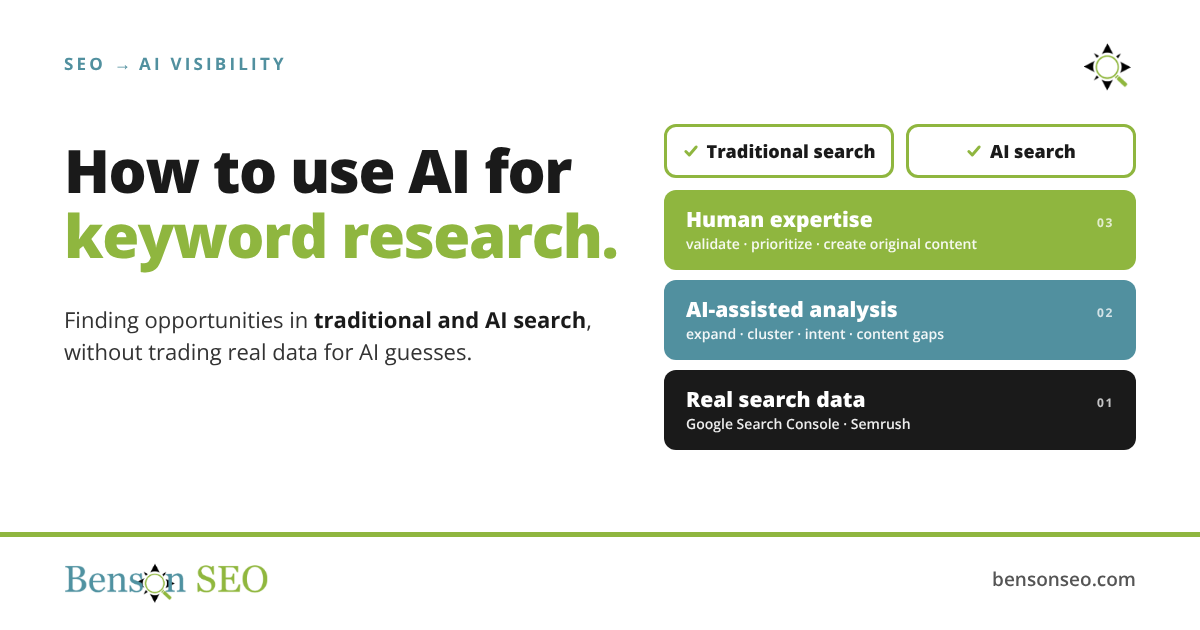
The most effective approach combines three elements:
- Reliable search data from Google Search Console, SEMRush, and other research tools.
- AI-assisted analysis for discovering topics, clustering keywords, evaluating intent, and identifying content gaps.
- Human expertise to validate opportunities, understand business priorities, and develop original content.
As search continues to evolve, businesses should also expand their research to consider conversational questions and the information people seek through AI-powered search experiences. That doesn’t mean abandoning traditional keyword research. It means using AI to make the process more efficient while broadening your understanding of how customers discover information. At Benson SEO, we combine traditional SEO research, technical analysis, content strategy, and AI visibility monitoring to help businesses identify opportunities across search experiences.
Learn more about our AI Optimization Services and how we help organizations improve their visibility in traditional and AI-powered search.
Frequently Asked Questions
Can ChatGPT perform keyword research?
Yes. ChatGPT can help generate keyword ideas, group related phrases, classify search intent, analyze exported keyword data, and develop content briefs. However, it should not be relied upon to produce accurate search volume or keyword difficulty estimates without access to reliable data sources.
How do I use AI for keyword research?
Start with keyword data from Google Search Console or a keyword research platform. Use AI to expand related topics, group keywords by intent, identify content gaps, and develop a prioritized content plan. Validate all quantitative metrics before making decisions.
What are the best AI tools for keyword research?
ChatGPT and similar AI assistants are useful for brainstorming, semantic analysis, clustering, and content planning. Platforms such as SEMRush and Google Search Console provide essential search performance and keyword data. Combining these tools is generally more useful than relying on one alone.
Can AI find long-tail keywords?
Yes. AI can suggest longer, more specific search phrases based on a broad topic, target audience, or business challenge. However, those suggestions should be validated using actual search data before being treated as established keyword opportunities.
Is keyword research still important for AI search?
Yes. Traditional keyword research helps businesses understand search demand, user intent, and relevant topics. AI search research adds conversational questions, detailed buyer requirements, and brand visibility considerations. Together, these approaches support a more complete search strategy.
Can AI help prevent keyword cannibalization?
AI can help identify overlapping keywords and existing pages that target similar subjects. It can recommend consolidation or differentiation, but those recommendations should be reviewed against actual search results, ranking URLs, and existing page performance.


Leave a Reply